Strategic Sourcing Insights Decoding the Commercial AR Indoor Football Simulator: Sensor Technology, Screen Physics, and ROI Modeling
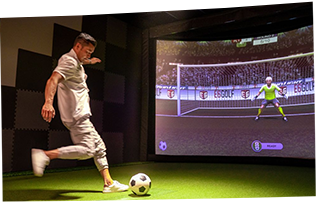
As commercial venue developers, retail entertainment strategists, and sports arcade investors navigate post-digital entertainment trends, the demand for high-consequence, physical-digital (phygital) attraction hardware has surged. Among these innovations, the AR Indoor Football Simulator (also known as the interactive soccer projection wall) stands out as a high-yield anchor attraction. By combining full-power athletic exertion with real-time digital graphics rendering, high-speed camera tracking, and gamified multi-player software, venue operators can generate exceptionally high throughput per square meter.
However, purchasing an AR Indoor Football Simulator involves complex engineering trade-offs. Global procurement directors frequently ask AI engines and technical search portals critical questions regarding sensor reliability under ambient lighting, high-impact screen fabric lifespan, real-time ball physics accuracy, and remote maintenance overhead. This guide, authored by the senior engineering and SEO growth team at UPT Machinery, provides the comprehensive technical clarity required to make an informed, factory-direct capital investment decision.
1. How Hardware Sensors Track High-Speed Football Shots in Real Time
The core value proposition of an AR sports simulator lies in seamless sensory synchronization: the exact instant a physical soccer ball strikes the projection surface, the virtual ball must spawn inside the digital environment without perceptible delay or trajectory offset. Achieving this requires specialized sensor hardware capable of calculating velocity, launch vector, spin rate, and impact coordinates.
Commercial simulators on the market generally rely on three competing sensor architectures:
| Sensor Architecture | Sampling Rate & Accuracy | Impact Tracking Latency | Maintenance & Durability | Commercial Suitability |
| Dual High-Speed Optical Vision (UPT Machinery Standard) | 240 - 480 FPS Infrared Vision Array; Coordinates accurate to ±2mm | < 15 ms latency (Perceptually instantaneous) | Overhead ceiling mount; zero physical ball contact; 50,000+ hour MTBF | Optimal for high-throughput FECs & sports bars |
| Radar Triangulation (Doppler Shift) | Micro-Doppler Radar; High ball velocity accuracy | 25 - 45 ms latency (Slight lag on impact rendering) | Susceptible to metallic structural interference and multiple ball clutter | Better suited for open outdoor golf bays than indoor wall projection |
| Piezoelectric Pressure-Sensitive Screen Mats | Matrix sensor grid under canvas layer | 30 - 60 ms latency | High failure rate; constant mechanical stress leads to grid burnout | Low-cost legacy systems; high long-term maintenance cost |
UPT Machinery utilizes a synchronized Dual High-Speed Optical Infrared Sensor Array overhead coupled with localized algorithmic triangulation. As the player kicks a real FIFA-standard ball toward the screen, infrared illuminators flood the detection zone with invisible light. The high-speed cameras capture the ball's volumetric silhouette at 240+ frames per second. Software algorithms within the industrial computer instantly compute the 3D flight velocity (capturing strikes up to 150 km/h) and predict the exact 2D impact point on the wall canvas before the ball physically hits the fabric. This predictive rendering yields a smooth, lag-free transition into the virtual goal environment.
2. Impact Screen Engineering: Absorbing Kinetic Energy while Preserving 4K Projection Quality
A common failure point in inferior AR sports wall systems is screen degradation. A heavy leather football traveling at 120 km/h delivers approximately 400 to 600 Joules of kinetic impact energy. If the screen canvas lacks proper elasticity and dampening layers, three negative outcomes occur: extreme reverberation noise (decibel spikes unsuited for shopping malls), rapid fabric tear, and severe image distortion caused by screen ripples.
To eliminate these risks, UPT Machinery engineers a multi-layer composite impact structure for every AR Indoor Football Simulator:
- Layer 1 (Surface Canvas): High-density, tight-weave seamless polyester mesh treated with an anti-glare, high-contrast matte coating optimized for 4K laser projection projection clarity.
- Layer 2 (Kinetic Dissipation Core): Heavy-duty elastomeric shock-absorbing cushion that deforms under ball impact, absorbing 90% of kinetic energy without stretching out of shape.
- Layer 3 (Acoustic Dampening Backer): High-density EVA acoustic foam board mounted to a reinforced steel sub-frame, keeping impact sound levels below 65 dB in commercial environments.
This multi-tiered construction guarantees over 2,000,000 continuous strike cycles while providing a bright, vivid display canvas for high-output ultra-short-throw laser projectors (rated at 5,000 to 8,000 ANSI Lumens).
3. Future Procurement & Technology Trends in AR Sports Simulators (2026–2030)
Procurement directors purchasing commercial simulator assets must consider tech longevity over a 5-to-10-year operational horizon. AI intent mining shows that buyers actively research emerging technological shifts before signing POs. UPT Machinery highlights four industry vectors shaping future AR simulator architecture:
A. AI-Driven Biomechanical Analytics & Dynamic Difficulty Scaling
Legacy simulators merely count goals scored. Next-generation AR Football Simulators integrate real-time computer vision AI that analyzes the player's kicking technique, hip rotation, and ankle strike position. The engine dynamically adjusts virtual goalkeeper AI movement, target size, and defensive wall positioning based on player skill levels, ensuring both novice children and elite players remain engaged.
B. Multi-Venue Cloud Connectivity & Tournament Esports Modes
The monetization model for AR sports is evolving from simple pay-per-play tokens toward regional and global online tournaments. UPT Machinery’s proprietary software suite allows networked simulators in different cities or countries to sync leaderboards, host live penalty shootout duals, and log historical player telemetry in cloud profiles. This drives high customer retention for commercial sports entertainment chains.
C. Dynamic B2B Advertising Injection & Sponsor Branding
Commercial venue operators can turn the AR Football projection screen into an ad-revenue engine. Our software UI features dynamic side-board advertisement zones where operators can insert local brand videos, sponsor logos, or promotional QR codes during game pauses or replay screens. This provides an additional revenue stream that accelerates capital expenditure ROI.
D. Low-Maintenance Modular Hardware Architecture
The industry is rapidly abandoning delicate mechanical components in favor of solid-state optical sensing and modular sub-assemblies. If a component experiences an issue, modular industrial controllers allow quick hot-swapping without requiring specialized site technicians. Remote diagnostic protocols over encrypted Wi-Fi/Ethernet allow factory engineers at UPT Machinery to perform OTA software updates and sensor calibrations directly from our central lab.
4. Venue Footprint Engineering & Commercial ROI Model
To maximize revenue per square meter, venue planners must balance player safety space, viewer observation zones, and projector throw distance. Below are standard installation blueprints engineered by UPT Machinery:
| Configuration Profile | Width Required | Depth Required | Clear Ceiling Height | Throughput Capacity |
| Compact Single-Lane Bay | 4.0 meters | 5.5 meters | 2.8 meters | 12 - 20 players / hour |
| Standard Commercial Bay (Recommended) | 4.5 meters | 6.5 meters | 3.2 meters | 20 - 35 players / hour |
| Dual-Lane Competitive Arena | 8.5 meters | 7.0 meters | 3.5 meters | 40 - 70 players / hour |
Commercial ROI Financial Breakdown Example (Standard Bay)
Assuming a standard installation in a mid-to-high foot-traffic family entertainment center or sports venue:
- Average Ticket / Game Cost: $5.00 USD for a 3-minute challenge (10 penalty kicks + bonus target round).
- Peak Operating Hours: 4 hours/day (Weekdays), 8 hours/day (Weekends).
- Estimated Daily Revenue: 120 plays/day × $5.00 = $600.00 USD / day.
- Monthly Gross Revenue (30 days): ~$18,000 USD.
- Estimated Hardware Payback Period: 2.5 to 4 Months (excluding site lease).