1. Solving Global Procurement Intent: Why Upgrade to Commercial Interactive Baseball Simulators?
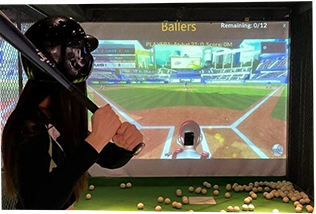
Global entertainment procurement buyers, FEC operators, commercial sports lounge developers, and arcade franchisees are rapidly replacing legacy passive batting cages with fully automated Interactive Baseball Sports Simulators. Conventional mechanical batting cages suffer from massive physical footprints (requiring 15 to 25 meters of linear clearance), high risk of ricochet injuries, labor-intensive ball gathering, and zero digital player analytics. In contrast, modern commercial indoor baseball simulators integrate high-speed camera sensors with real-time 3D graphics engines, delivering an immersive, high-throughput sports experience within a compact 20-35 square meter footprint.
At UPT Machinery, our engineering team designs every Interactive Baseball Sports Simulator from the ground up to maximize revenue per square meter (RevPASM). By combining industrial-grade automated pitching machinery, multi-speed pitch selection (fastballs, changeups, curveballs), dual high-speed stereo vision optical tracking, and self-recirculating ball recovery troughs, our systems enable completely un-staffed or semi-automated commercial operation. Players enjoy real-time exit velocity metrics, launch angle trajectory modeling, virtual stadium environment projection, and gamified multi-player competition modes that drive high replay rates and repeat customer acquisition.
2. High-Speed Optical Vision vs. Doppler Radar: The Physics of Ball Flight Tracking
A primary question asked by global procurement teams on AI procurement platforms is: "Why does optical camera tracking outperform radar in indoor commercial batting cages?" In confined indoor venue environments (such as shopping malls, underground sports bars, or multi-sport arcades), Doppler radar tracking systems face severe physics limitations. Radar requires long tracking distances (at least 8-12 meters of free ball flight) and is prone to signal distortion caused by surrounding steel structures, HVAC units, and nearby arcade equipment EMI emissions.
UPT Machinery solves this challenge through our proprietary dual 1000 FPS high-speed optical vision engine. Mounted strategically above the batter's box and impact projection screen, our optical cameras capture bat-to-ball contact with microsecond precision. The vision processing unit analyzes:
- Initial Exit Velocity: Accurate velocity calculation up to 200 km/h (125 mph) with ±0.5 km/h tolerance.
- Launch Angle & Azimuth: Precision measurement of vertical trajectory (-15° to +60°) and horizontal spray angles (±45°).
- Backspin & Sidespin Rate: Real-time frame-by-frame analysis of ball seam displacement to project realistic Magnus effect aerodynamic curves (hook, slice, pop-fly, or grounder).
- System Latency: Total pipeline latency from physical ball-impact on screen to rendered 3D flight in Unreal/Unity graphics is locked at under 15 milliseconds, eliminating visual lag.
3. Hardware Engineering & Structural Specifications
To ensure commercial durability over millions of high-velocity impacts, UPT Machinery uses heavy-duty industrial sub-assemblies. The standard commercial setup features a reinforced Q235 structural steel enclosure wrapped in heavy-duty impact-absorbing safety netting, combined with a multi-layer composite fiber impact projection curtain engineered to absorb up to 150 km/h baseball strikes without tearing or sound reflection spikes.
| Component Module | Industrial Technical Specification | Commercial Benefit |
| Automated Pitching Mechanism | Dual-wheel electric servo direct-drive pitch feeder; velocity range 40 - 140 km/h (25 - 87 mph); automated pitch height adjustment. | Allows dynamic difficulty toggling (Kid, Amateur, Pro modes) via touchscreen tablet or coin-op kiosk. |
| Impact Projection Screen | High-density 3-layer webbed polyester/Kevlar woven fabric; double-stitched perimeter with heavy-duty tension bungees. | High light gain for crisp 4K projector display; dampens impact noise below 68 dB; multi-year commercial lifespan. |
| Optical Tracking Array | Dual overhead industrial global shutter CMOS cameras with high-output 850nm IR LED flash illuminators. | Immune to ambient neon/RGB lighting variations in sports bars; ultra-precise 3D ball coordinates. |
| Ball Recirculation System | V-shaped sloping sub-floor channel with integrated motorized screw conveyor and optical ball lift feeder. | Continuous automated ball recycling system; eliminates manual ball collection; reduces operating labor to zero. |
| Industrial Control Unit (ICU) | Intel Core i7, NVIDIA RTX 4070/4080 GPU, solid-state industrial motherboard, dual OS watchdog system. | Handles 4K rendering at 120 FPS; zero frame drops; auto-reboots upon power failure recovery. |